Learn More
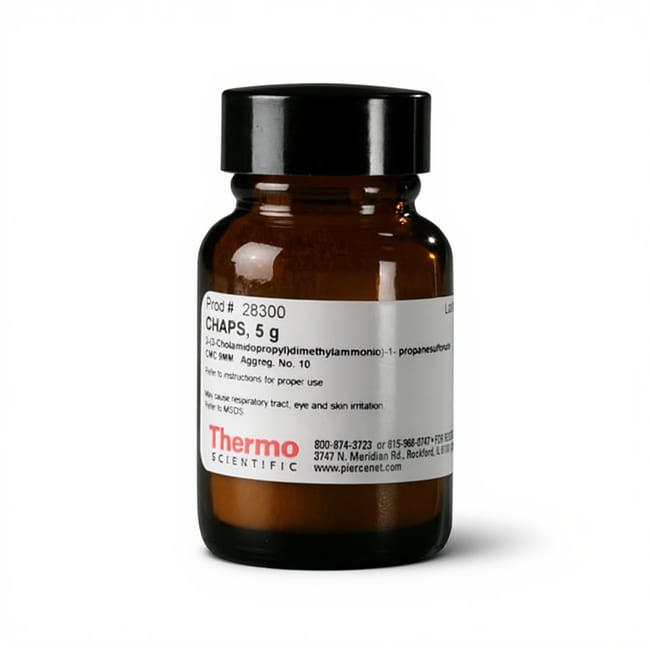


Thermo Scientific™ CHAPS Detergent (3-((3-cholamidopropyl) dimethylammonio)-1-propanesulfonate)
Shop All Thermo Scientific ProductsLog in to see stock.

BEST PRICE on Promo! Use promo code "27967" to get your promotional price.
Description
Thermo Scientific™ CHAPS is a zwitterionic detergent that is especially well suited for protecting the native state of proteins.
CHAPS is a sulfobetaine derivatives of cholic acid. This zwitterionic detergent is useful for membrane protein solubilization when it is important to maintain protein activity. CHAPS detergent is soluble over a wide range of pH (2 to 12) and are easily removed from solution by dialysis because of their high critical micelle concentration (CMC).
Highlights:
- Versatile zwitterionic detergents
- Provide mild but effective lysis of cultured mammalian cells
- Nondenaturing and generally do not inactivate protein functions
- Can be removed from solution by dialysis
- Commonly used for isoelectric focusing (IEF) and 2D electrophoresis
Properties of CHAPS detergent:
- Chemical Name: 3-[(3-Cholamidopropyl)dimethylammonio]-1-propanesulfonate
- Molecular Weight: 614.88
- Detergent Class: Zwitterionic
- Aggregation Number: 10
- Micelle Molecular Weight: 6149
- Critical Micelle Concentration (CMC): 8 to 10mM (0.4920 to 0.6150%, w/v)
- Cloud Point: ≥ 100°C
- Dialyzable: Yes

Specifications
Specifications
| Product Type | Detergent |
| Content And Storage | Store at Room Temperature |
| Form | Powder |
| Reagent Type | Detergent (Pure) |
| Quantity | 5 g |
Frequently Asked Questions (FAQs)
CHAPS (Cat. Nos. 28299, 28300), OTG (Cat. No. 28351) and Sodium Deoxycholate (Cat. Nos. 89904, 89905) are detergents often used to solubilize and extract membrane proteins from samples
Ionic detergents, or those that carry a charge, are the most likely to be denaturing to proteins. Denaturing detergents can be anionic such as sodium dodecyl sulfate (SDS) or cationic such as ethyl trimethyl ammonium bromide. These detergents totally disrupt membranes and denature proteins by breaking protein-protein interactions through changes in the three-dimensional structure of the proteins. Nondenaturing detergents can be divided into nonionic detergents (i.e., Triton X-100), bile salts (i.e., cholate), and zwitterionic detergents (i.e., CHAPS).
Detergents are amphipathic molecules containing both a nonpolar “tail” having aliphatic or aromatic character, and a polar “head”. The ionic character of the polar head group forms the basis for broad classification of detergents as ionic, nonionic, or zwitterionic.
Detergents are amphipathic molecules, meaning they contain both a nonpolar “tail” having aliphatic or aromatic character and a polar “head”. Like the components of biological membranes, detergents have hydrophobic-associating properties as a result of their nonpolar tail groups. Nevertheless, detergents are themselves water soluble.
Consequently, detergent molecules allow the dispersion (miscibility) of water-insoluble, hydrophobic compounds into aqueous media, including the extraction and solubilization of membrane proteins. Detergent monomers solubilize membrane proteins by partitioning into the membrane bilayer. With increasing amounts of detergents, membranes undergo various stages of solubilization.
Detergents can be denaturing or non-denaturing with respect to protein structure. Denaturing detergents can be anionic such as sodium dodecyl sulfate (SDS) or cationic such as ethyl trimethyl ammonium bromide. These detergents totally disrupt membranes and denature proteins by breaking proteinprotein interaction. These detergents are considered harsh. Non-denaturing detergents can be divided into nonionic detergents (i.e., Triton X-100), bile salts (i.e., cholate), and zwitterionic detergents (i.e., CHAPS). These detergents do not denature proteins and do not break protein-protein interactions. These detergents are considered mild.
For Research Use Only. Not for use in diagnostic procedures.
By clicking Submit, you acknowledge that you may be contacted by Fisher Scientific in regards to the feedback you have provided in this form. We will not share your information for any other purposes. All contact information provided shall also be maintained in accordance with our Privacy Policy.