missing translation for 'onlineSavingsMsg'
Learn More

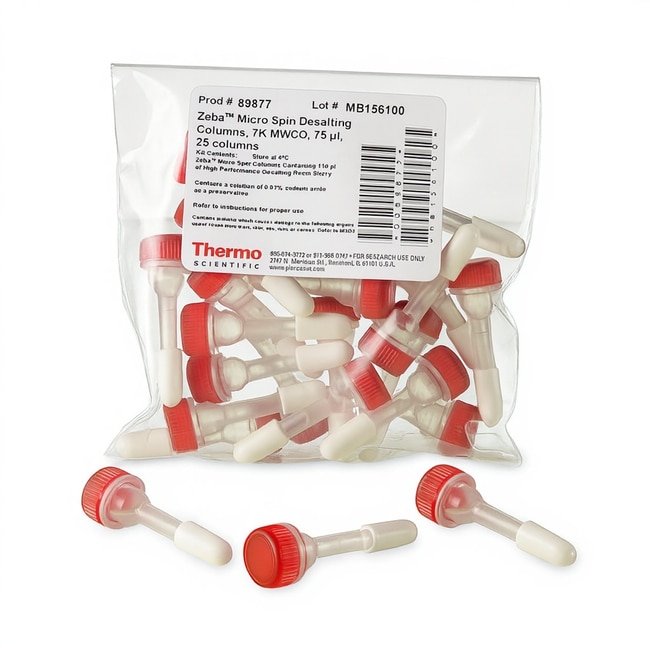
Thermo Scientific™ Zeba™ Spin Desalting Columns, Plates, and Cartridges, 7K MWCO, 0.5–100 mL

Product Code. 10290384 Shop All Thermo Scientific Products
Change view
Click to view available options
Quantity:
1 column x 5 mL
10 Columns
2 Plates
25 Columns
4 Plates
5 Columns
5 columns x 1 mL
50 Columns
Format:
96-well Filter Plate
Chromatography Cartridge
Spin Column
Volume (Metric):
0.5 mL
1 mL
10 mL
2 mL
20 mL
5 mL
75 μL
96-well
Unit Size:
Pack of 10
Pack of 2
Pack of 25
Pack of 4
Pack of 5
Pack of 50
16 product options available for selection
Product selection table with 16 available options. Use arrow keys to navigate and Enter or Space to select.
Product Code. Quantity Format Volume (Metric) unitSize
10290384 25 Columns Spin Column 75 μL Pack of 25
10678294 50 Columns Spin Column 75 μL Pack of 50
30245403 5 Columns Spin Column 20 mL Pack of 5
30245279 10 Columns Spin Column 20 mL Pack of 10
10627354 25 Columns Spin Column 2 mL Pack of 25
10657514 5 Columns Spin Column 5 mL Pack of 5
10280584 25 Columns Spin Column 5 mL Pack of 25
10667514 5 Columns Spin Column 10 mL Pack of 5
10435725 25 Columns Spin Column 10 mL Pack of 25
10415545 5 Columns Spin Column 2 mL Pack of 5
10341164 25 Columns Spin Column 0.5 mL Pack of 25
10056033 50 Columns Spin Column 0.5 mL Pack of 50
11844161 5 columns x 1 mL Chromatography Cartridge 1 mL Pack of 5
11854161 1 column x 5 mL Chromatography Cartridge 5 mL Pack of 5
10667524 2 Plates 96-well Filter Plate 96-well Pack of 2
10698674 4 Plates 96-well Filter Plate 96-well Pack of 4
Use arrow keys to navigate between rows. Press Enter or Space to select a product option. 16 options available.
16 options
This item is not returnable. View return policy
Product Code. 10290384 Supplier Thermo Scientific™ Supplier No. 89877

Please to purchase this item. Need a web account? Register with us today!

This item is not returnable. View return policy

Perform high-throughput protein recovery (7K MWCO) and sample desalting for mass spectrometry, HPLC, capillary electrophoresis, metabolite screening, and assay development with ready-to-use Thermo Scientific Pierce Zeba desalting chromatography columns, plates, and cartridges.

Perform high-throughput protein recovery and sample desalting for mass spectrometry, HPLC, capillary electrophoresis, metabolite screening, and assay development with ready-to-use Pierce Zeba desalting chromatography columns, plates, and cartridges. Rapidly desalt protein and biological samples for manual or automated liquid chromatography (LC) with ≥95% retention of salts and other small molecular contaminants (<1,000 Da).

Zeba Spin Desalting columns, plates, and chromatography cartridge fittings are convenient, ready-to-use devices compatible with major automated liquid-chromatography systems or for manual syringe processing. The polypropylene columns have a 7K MWCO and contain a proprietary high-performance size-exclusion chromatography resin (Zeba High-Performance Resin) that offers excellent protein desalting and recovery in a centrifuge format. When using Zeba Spin Desalting Columns, even very dilute (25 μg/mL) protein samples can be successfully processed to obtain greater than 95% retention (removal) of salts and other small molecules (<1000 MW), and good recovery of proteins and other macromolecules (>7000 MW).

Similarly, Zeba Desalting plates (7K MWCO) are polypropylene devices that contain Zeba High-Performance Resin and provide excellent protein desalting performance, with high recovery of proteins >7000 Da in a centrifuge format for small sample volumes. The plates enable fast, consistent, well-to-well and plate-to-plate reproducibility for small-scale, high-throughput separations. Zeba 96-well spin desalting plates require no resin dispensing or hydration and provide the same high protein recovery as spin columns with at least 95% removal of salts and other small molecules. One plate can process 96 small sample volumes (20 to 100 μL) in just five minutes, offering rapid and exceptional protein desalting.

The Zeba Desalting Chromatography Cartridges contain Zeba High-Performance Resin for desalting or buffer exchange applications. This resin is ideal for removing low molecular weight compounds including salts, fluorescent dyes, biotin, and other small labeling reagents. Protein samples can be processed with unsurpassed protein recovery and 95% retention of salts and other small molecular contaminants (<1,000 Da). Zeba Desalting cartridges provide fast, easy, and reproducible chromatographic separations and can be regenerated for multiple uses.

Benefits of Zeba Spin Desalting columns, plates, and cartridges include:
High recovery—low-binding resin maximizes protein recovery
Fast—no fraction screening or waiting for protein to emerge by gravity flow
Economical—great performance at lower cost than other commercially available cartridges
Easy-to-use—no cumbersome column preparation or equilibration
Flexible—available in spin columns, filter spin plates and cartridges for a range of needs

Available formats
Spin columns—75 μL, 0.5 mL (microcentrifuge), 2 mL, 5 mL, 10 mL columns
96-well spin plates—pre-dispensed 96-well filter plates, compatible with centrifugation for manual or automated purification
Chromatography cartridges—compatible with automated liquid chromatography systems and with syringe processing

TRUSTED_SUSTAINABILITY

Specifications

Product Type Spin Desalting Column
Content And Storage Upon receipt store at 4°C.
Format Spin Column
Purification Target Buffer Exchange, Protein
Column Type Size-exclusion, Proprietary Resin
MWCO 7.0 kDa
Product Line Zeba
Quantity 25 Columns
Volume (Metric) 75 μL
Sample Volume (Metric) 2 to 12 μL
Besides precipitation with ammonium sulfate, what are some ways I can concentrate my protein sample?

You may remove excess solvent and smaller moieties by centrifugation through a microconcentrator. This will concentrate your protein sample.

(1) Choose microconcentrator tube (available from a variety of commercial suppliers) with a protein cutoff smaller than the molecular weight of the protein in the sample. Check our Pierce Protein Concentrators PES.

(2) Add 1 µL of 20% w/v SDS to a dry microconcentrator tube (if sample does not already contain SDS).

(3) Slowly add sample (a few microliters at a time) to membrane until membrane is completely wet. Centrifuge to near (but not complete) dryness.

(4) If intention is to desalt sample or buffer exchange: Add ~50 µL water to microconcentrator and spin until nearly dry. Repeat buffer exchange. Sample will remain on membrane. Check our Zeba desalting proteins.

(5) Using a new collection tube, invert membrane and spin at low speed (1000 x g) to elute protein from membrane. Add 2X SDS-Sample Buffer containing 10 mM DTT to membrane: vortex, invert and spin. Final volume should be ~20 µL.

Can Zeba Desalting columns, plates, and cartridges be autoclaved?

Yes, Zeba Desalting columns, plates, and cartridges can be autoclaved at 115 degrees C for 30 min.

What reagents and conditions are Zeba Desalting columns, plates, and cartridges compatible with?

Zeba Desalting columns, plates, and cartridges are compatible with a range of reagents and conditions. They have been confirmed to be compatible with the following:
- pH range of 3-10
- Mild oxidants/reductants
- Chaotropes (stable in 8 M urea and 6 M guanidine HCl)
- Salts
- Alcohols up to 20%
- Organic solvents such as dimethyl sulfoxide (DMSO) and dimethylformamide (DMF) (we recommend using a step-gradient of increasing concentration of the organic solvent during column equilibration)

How should I store Zeba Spin Desalting Columns, Plates, and Cartridges?

We recommend storing Zeba Spin Desalting Columns, Plates, and Cartridges at 4 degrees C.

What product do you recommend for removing sodium azide from the Alix Monoclonal Antibody (3A9) (Cat. No. MA1-83977) storage solution?

We recommend using Zeba Spin Desalting Columns, Plates, and Cartridges (Cat. No. 89882, 89883) to remove sodium azide from the Alix Monoclonal Antibody (3A9) storage solution.

Can you provide the shelf life for Zeba Spin Desalting columns?

Zeba Spin Desalting columns are covered under our general 1-year warranty and are guaranteed to be fully functional for 12 months from the date of shipment, if stored as recommended. Please see section 8.1 of our Terms & Conditions of Sale (https://www.thermofisher.com/content/dam/LifeTech/Documents/PDFs/Terms-and-Conditions-of-Sale.pdf).

I used a Zeba desalting column, but it is not completely getting rid of glycerol and detergent from my sample. What should I do?

Glycerol and sugars add viscosity to a sample, while detergents create micelles, making the removal of each difficult. Although dialysis is a better choice for removing these components, Zeba Columns can be used by modifying the desalting protocol. Modifications include diluting the samples, processing smaller samples, and adding the sample slowly to the column allowing it to enter the gel and equilibrate into the pores before centrifugation.

After desalting with your Zeba desalting columns, I still have leftover salts in my sample. What should I do to get rid of all the salt?

You can either reduce the volume of sample processed in each column (the product manual indicates the volume range recommended for each column size) or run the flow-through from one column over a fresh column.

Can Zeba Columns be used for glycerol and detergent removal?

Glycerol and sugars add viscosity to a sample, while detergents create micelles, making the removal of each difficult. Although dialysis is a better choice for removing these components, Zeba Columns can be used by modifying the desalting protocol. Modifications include diluting the samples, processing smaller samples, and adding the sample slowly to the column allowing it to enter the gel and equilibrate into the pores before centrifugation.

Is my sample likely to become diluted following desalting with Zeba columns?

Centrifuged-based desalting results in minimal dilution. A slight dilution of the protein solution results if the optional stacker buffer is added that ensures maximum protein recovery.

When used properly, the volume recovered from the column equals the volume of sample (and buffer) added to the column.

Can Zeba columns be regenerated and stored after use?

Zeba columns are designed to be used once and discarded after use.

Can I remove DyLight, Alexa Fluor or other dyes using the desalting columns?

No, excess amounts of DyLight dyes (and any other planar molecule with multiple rings in their structure) “act” larger than their stated molecular weights in desalting columns. We do not recommend desalting, but refer researchers to our Pierce Dye Removal Columns (Cat. No. 22858) for this purpose.

Can I use Zeba columns for nucleic acids?

Yes, the 7K Zeba columns have good recovery of dsDNA ladder down to 10 bp.

Are Zeba columns compatible with salts/organics?

Yes, Zeba columns are compatible with most salts. The resin is stable to some organics. As organics may affect performance, we suggest using less than 10% organics.

How do your Zeba desalting products work?

A centrifuge is used to first remove the resin‘s void volume of liquid, followed by sample addition and centrifugation. After centrifugation, the macromolecules in the sample have moved through the column in approximately the same initial volume, but the small molecules have been forced into the pores of the resin and replaced by the buffer that was used to pre-equilibrate the gel-filtration matrix. Spin formats eliminate the need to wait for samples to emerge by gravity flow and require no chromatography system, allowing for multiple-sample processing simultaneously.

Note: The addition of larger volumes of buffer or longer centrifugation times than listed in the protocol will result in smaller molecules eventually emerging from the desalting column.

What is desalting?

Desalting is the process where porous particles or beads are used to separate molecules of different sizes (known as gel filtration or size exclusion). Small molecules enter into the pores in the resin, resulting in a longer path length through the desalting column when compared to large molecules which pass in the space between the beads This increased path length for molecules below the MWCO allows the separation of small and large molecules.

Our desalting resins are rated by what MWCO molecules can pass through. They also have a lower MWCO (1K or 2K) that can be effectively separated from larger molecules. Molecules in between these values cannot be effectively separated from larger or smaller molecules, given our protocols.


Product Title
Select an issue

By clicking Submit, you acknowledge that you may be contacted by Fisher Scientific in regards to the feedback you have provided in this form. We will not share your information for any other purposes. All contact information provided shall also be maintained in accordance with our Privacy Policy.