missing translation for 'onlineSavingsMsg'
Learn More
Learn More
Invitrogen™ CD48 Monoclonal Antibody (HM48-1), NovaFluor™ Yellow 610, eBioscience™
Armenian Hamster Monoclonal Antibody
Brand: Invitrogen™ M031T02Y03-A
This item is not returnable.
View return policy
Description
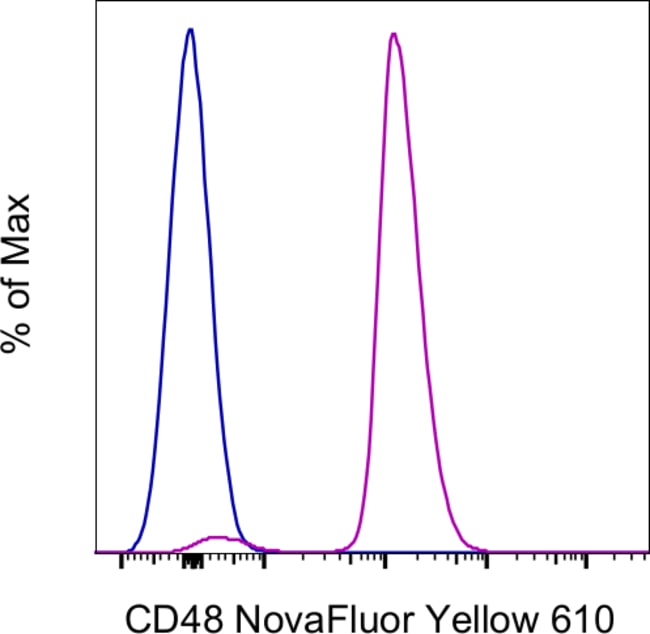
Description: The HM48-1 monoclonal antibody reacts with the mouse CD48 antigen; also known as BCM1, Blast-1 (human), and OX-45 (rat). In the mouse, the primary counter-receptors for CD48 are CD2 and CD244. HM48-1 is reported to modulate in vitro and in vivo CD48 functions including blocking the CD48/CD2 and CD48/CD244 interactions, inhibiting the proliferative response of mitogen-activated spleen cells, providing a costimulation signal for T cells activated in vitro through their TCR, and prolonging cardiac allograft survival in vivo. This product contains 1 vial of NovaFluor conjugate and 1 vial of CellBlox Plus Blocking Buffer. Applications Tested: This HM48-1 antibody has been tested by flow cytometric analysis of mouse splenocytes. This can be used at less than or equal to 0.125 μg per test. A test is defined as the amount (μg) of antibody that will stain a cell sample in a final volume of 100 μL. Cell number should be determined empirically but can range from 10^5 to 10^8 cells/test. It is recommended that the antibody be carefully titrated for optimal performance in the assay of interest Master mixes.
CD48, also known as Blast-1, is a 45 kDa glycoprotein that is part of the SLAM and Ig superfamilies. It is a GPI-anchored protein broadly expressed on most hematopoietic cells, including lymphocytes and monocytes, but is weakly expressed on granulocytes and absent on platelets, fibroblasts, epithelium, and endothelium. CD48 plays a critical role in adhesion and T cell activation, serving as a high-affinity ligand for 2B4 and a low-affinity ligand for CD2. The interaction between 2B4 and CD48 among NK and NK-T cells regulates cell proliferation. CD48 is involved in eosinophil activation and its expression increases in several infectious diseases. It is also a marker for detecting defects in the GPI anchoring structure in patients with paroxysmal nocturnal hemoglobulinuria (PNH). Recent studies have highlighted the differential expression of SLAM family members, including CD48, CD150, and CD244, among bone marrow hematopoietic progenitors. This provides a useful tool for predicting the primitiveness of hematopoietic progenitors: hematopoietic stem cells (HSCs) are CD150(+)CD244(-)CD48(-), non-self-renewing multipotent progenitors (MPPs) are CD244(+)CD150(-)CD48(-), and the most restricted progenitors are CD48(+)CD244(+)CD150(-). Additionally, the 2B4-CD48 interaction may be involved in the pathology of allergic airway diseases, offering a potential pharmacological target for treating conditions like allergic rhinitis and asthma.
Specifications
| CD48 | |
| Monoclonal | |
| 0.1 mg/mL | |
| PBS with 0.09% sodium azide; pH 7.2 | |
| P18181 | |
| Cd48 | |
| Affinity chromatography | |
| RUO | |
| 12506 | |
| 4°C, store in dark, DO NOT FREEZE! | |
| Liquid | |
| IgG |
| Flow Cytometry | |
| HM48-1 | |
| NovaFluor Yellow 610 | |
| Cd48 | |
| AI449234; AW610730; B-cell activation marker; BCM1; Bcm-1; BCM1 surface antigen; BLAST; BLAST1; BLAST-1; B-lymphocyte activation marker BLAST-1; Cd48; CD48 antigen; CD48 antigen (B cell membrane protein); CD48 antigen (B-cell membrane protein); Cd48 molecule; CD48d; hCD48; HM48-1; leukocyte antigen MEM-102; mCD48; MEM-102; MRC OX-45 surface antigen; sCD 48; sCD48; Sgp-60; Signaling lymphocytic activation molecule 2; Signaling lymphocytic activation molecule 2 (SLAMF2); SLAM family member 2; SLAMF2; soluble CD 48; soluble CD48; TCT.1 | |
| Armenian Hamster | |
| 25 μg | |
| Primary | |
| Mouse | |
| Antibody | |
| Liquid |
Product Content Correction
Your input is important to us. Please complete this form to provide feedback related to the content on this product.
Product Title
Spot an opportunity for improvement?Share a Content Correction