Learn More


Invitrogen™ CD3e Monoclonal Antibody (SP7)


Description
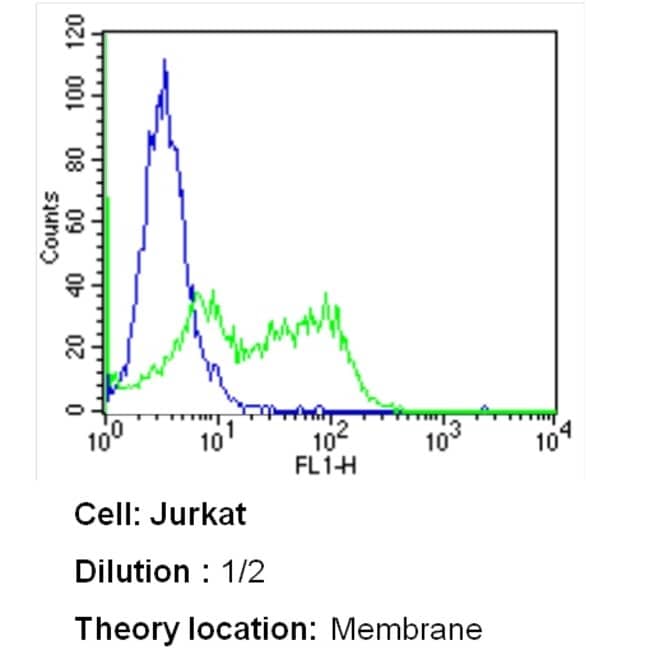
This antibody reacts with the intracytoplasmic portion of CD3 and stains human T cells in both the cortex and medula of the thymus and in peripheral lymphoid tissues. This antibody is suitable for staining normal and neoplastic T cells in formalin-fixed, paraffin embedded tissues. For tissue staining, antigen retrieval is suggested by boiling tissue sections in 10mM citrate buffer, pH 6.0 for 10 minutes followed by cooling at room temperature for 20 minutes. This antibody is predicted to react with Sheep, Rabbit, Horse, Chicken, Cow, Cat, Dog, Baboon, and Woodchuck. Recommended positive controls: WB - Recombinant human CD3e protein, Jurkat whole cell lysate, Human, mouse and rat thymus tissue lysate IHC (P) - Pig and rat spleen tissue, human tonsil tissue, mouse epidydimal fat pad and lymph node tissues, rat infarcted heart and spleen tissues Flow Cytometry - Human peripheral blood lymphocytes, Jurkat cells IHC (F) - Mouse brain tissue.

Specifications
Specifications
| Antigen | CD3e |
| Applications | Flow Cytometry, Immunohistochemistry (Paraffin), Western Blot |
| Classification | Monoclonal |
| Clone | SP7 |
| Concentration | 0.01 mg/mL |
| Conjugate | Unconjugated |
| Formulation | PBS with 1% BSA and 0.1% sodium azide; pH 7.2-7.4 |
| Gene | CD3g |
| Gene Accession No. | P04234, P04235, P07766, P09693, P11942, P19377, P20963, P22646, P24161, Q64159 |
| Gene Alias | 4930549J05Rik; A430104F18Rik; AI504783; antigen CD3D, delta polypeptide (TiT3 complex); antigen CD3E, epsilon polypeptide (TiT3 complex); antigen CD3G, gamma polypeptide; antigen CD3Z, zeta polypeptide; AW552088; Cd247; CD247 antigen; CD247 antigen, zeta subunit; Cd247 molecule; CD3; CD3 antigen delta chain; CD3 antigen delta polypeptide; CD3 antigen gamma chain; CD3 antigen, delta polypeptide; CD3 antigen, delta subunit; CD3 antigen, epsilon polypeptide; CD3 antigen, gamma polypeptide; CD3 antigen, zeta polypeptide; CD3 delta; CD3 epsilon; CD3 epsilon chain; CD3 epsilon subunit; CD3 epsilon subunit precursor; CD3 gamma-chain; CD3 glycoprotein; CD3 glycoprotein precursor; CD3 molecule delta polypeptide; CD3 molecule, delta; CD3 molecule, epsilon; CD3 molecule, epsilon polypeptide; CD3 molecule, gamma; CD3 molecule, gamma polypeptide; CD3 protein; CD3 TCR complex; CD3 type I transmembrane glycoprotein; CD3 type I transmembrane glycoprotein precursor; CD3 zeta chain; Cd3d; CD3D antigen delta; CD3D antigen, delta polypeptide (TiT3 complex); CD3d molecule; CD3d molecule, delta (CD3-TCR complex); CD3-DELTA; Cd3e; CD3E antigen, epsilon polypeptide; CD3E antigen, epsilon polypeptide (TiT3 complex); CD3e molecule; CD3e molecule, epsilon (CD3-TCR complex); CD3epsilon; CD3-epsilon; Cd3-eta; Cd3g; CD3G antigen, gamma polypeptide; CD3g antigen, gamma polypeptide (TiT3 complex); CD3g molecule; CD3g molecule, epsilon (CD3-TCR complex); CD3g molecule, gamma (CD3-TCR complex); CD3-GAMMA; Cd3h; CD3Q; Cd3z; CD3Z antigen, zeta polypeptide (TiT3 complex); Cd3zeta; Cd3-zeta; CD3zeta chain; CD3-zeta/eta; Ctg3; Ctg-3; FLJ18683; IMD17; IMD18; IMD19; IMD25; Leu-4; OKT3, delta chain; T cell antigen receptor complex epsilon subunit of T3; T3/TCR complex; T3d; T3e; T3g; T3Z; T-cell antigen receptor complex, epsilon subunit of T3; T-cell antigen receptor complex, gamma subunit of T3; T-cell antigen receptor complex, zeta subunit of CD3; T-cell receptor CD3 epsilon chain; T-cell receptor CD3 epsilon subunit; T-cell receptor CD3 subunit zeta; T-cell receptor CD3, subunit zeta; T-cell receptor T3 delta chain; T-cell receptor T3 eta chain; T-cell receptor T3 gamma chain; T-cell receptor T3 zeta chain; T-cell receptor zeta chain; T-cell surface antigen T3/Leu-4 epsilon chain; T-cell surface glycoprotein CD3 delta chain; T-cell surface glycoprotein CD3 epsilon chain; T-cell surface glycoprotein CD3 gamma chain; T-cell surface glycoprotein CD3 zeta chain; T-cell surface protein; TcR CD3 delta-chain; TcR CD3 gamma-chain; TCR zeta chain; TCR zeta chain subunit; TCRE; Tcrk; TCRZ; TCRzeta; TiT3 complex; type I transmembrane protein; T-cell surface molecule CD3 |
| Show More |
By clicking Submit, you acknowledge that you may be contacted by Fisher Scientific in regards to the feedback you have provided in this form. We will not share your information for any other purposes. All contact information provided shall also be maintained in accordance with our Privacy Policy.