missing translation for 'onlineSavingsMsg'
Learn More
Learn More
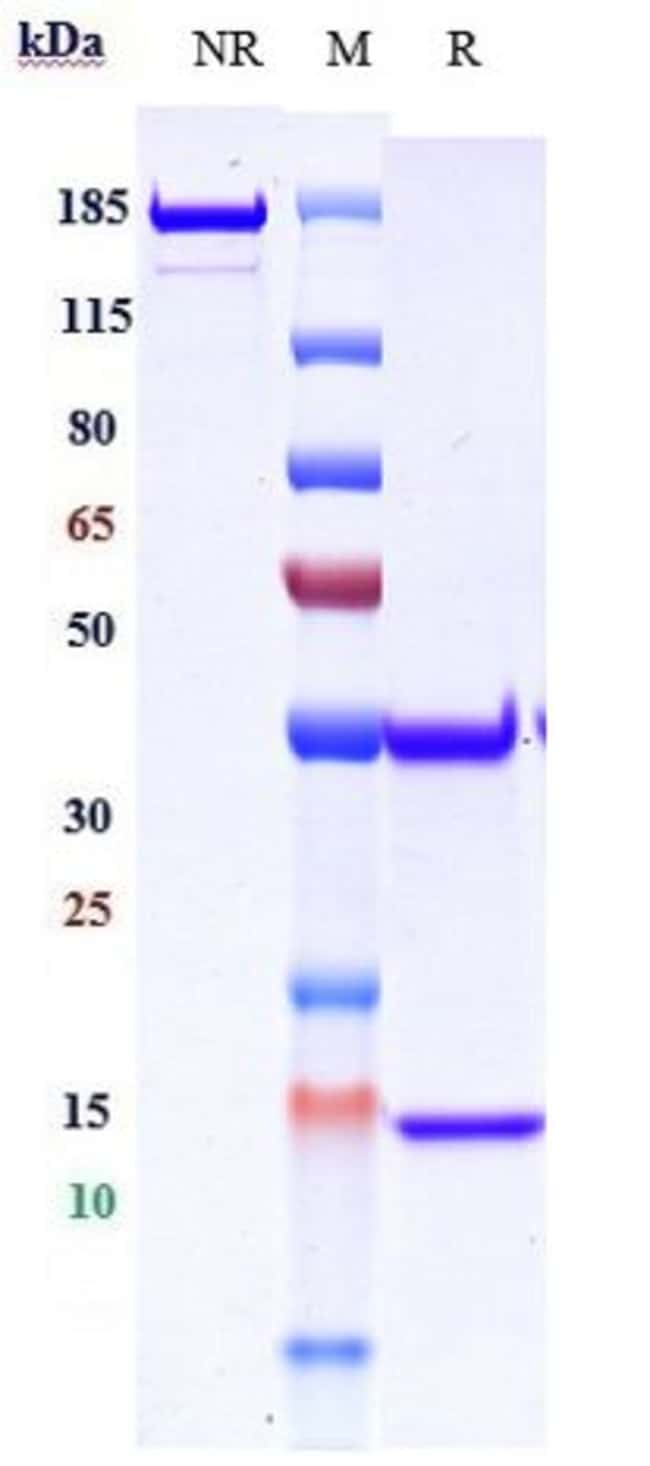
Invitrogen™ Demupitamab Recombinant Monoclonal Antibody
Recombinant Monoclonal Antibody
477.00 € - 1204.00 €
Specifications
| Antigen | Demupitamab |
|---|---|
| Concentration | 1 mg/mL |
| Content And Storage | -20°C, Avoid Freeze/Thaw Cycles |
| Applications | ELISA, Flow Cytometry, Functional Assay, Surface Plasmon Resonance |
| Classification | Recombinant Monoclonal |
| Product Code | Brand | Quantity | Price | Quantity & Availability | |||||
|---|---|---|---|---|---|---|---|---|---|
| Product Code | Brand | Quantity | Price | Quantity & Availability | |||||
|
30284775
|
Invitrogen™
MA559381 |
100 μg |
477.00 €
100µg |
Please sign in to purchase this item. Need a web account? Register with us today! | |||||
|
30284055
|
Invitrogen™
MA559382 |
1 mg |
1204.00 €
1mg |
Please sign in to purchase this item. Need a web account? Register with us today! | |||||
Description
For reconstitution, add sterile, distilled water to achieve a final antibody concentration of 1 mg/mL. Gently shake to solubilize the protein completely. Do not vortex. Reconstituted products should be stored at -80 °.
Demupitamab, also referred to as immunoglobulin G1-kappa, is a monoclonal antibody that targets the human epidermal growth factor receptor (EGFR or HER1). The ERBB1 gene, also known as EGFR (Epidermal Growth Factor Receptor), encodes a transmembrane receptor that is a member of the ErbB family of receptor tyrosine kinases (RTKs). This family also includes ErbB2 (HER2), ErbB3 (HER3), and ErbB4 (HER4). ERBB1/EGFR is located on chromosome 7p11.2 and consists of 28 exons. The receptor is activated by binding of specific ligands such as EGF and TGF-alpha, which induces conformational changes leading to dimerization, autophosphorylation, and downstream signaling through pathways such as MAPK, PI3K/AKT, and JAK/STAT. These signaling cascades regulate cell proliferation, survival, and differentiation. Aberrant activation of ERBB1/EGFR, often due to mutations, gene amplification, or overexpression, is implicated in various cancers, particularly non-small cell lung cancer (NSCLC), glioblastoma, and colorectal cancer. Targeted therapies, including tyrosine kinase inhibitors (TKIs) and monoclonal antibodies, have been developed to inhibit ERBB1/EGFR signaling, offering clinical benefits in treating EGFR-driven tumors.Specifications
| Demupitamab | |
| -20°C, Avoid Freeze/Thaw Cycles | |
| Recombinant Monoclonal | |
| Lyophilized | |
| IgG1 | |
| Human | |
| Primary | |
| Protein A |
| 1 mg/mL | |
| ELISA, Flow Cytometry, Functional Assay, Surface Plasmon Resonance | |
| Unconjugated | |
| Human | |
| RUO | |
| 25mM histidine with 8% sucrose, 0.01% Tween 80 and no preservative; pH 6.2 | |
| Antibody |
Spot an opportunity for improvement?Share a Content Correction
Product Content Correction
Your input is important to us. Please complete this form to provide feedback related to the content on this product.
Product Title