missing translation for 'onlineSavingsMsg'
Learn More
Learn More
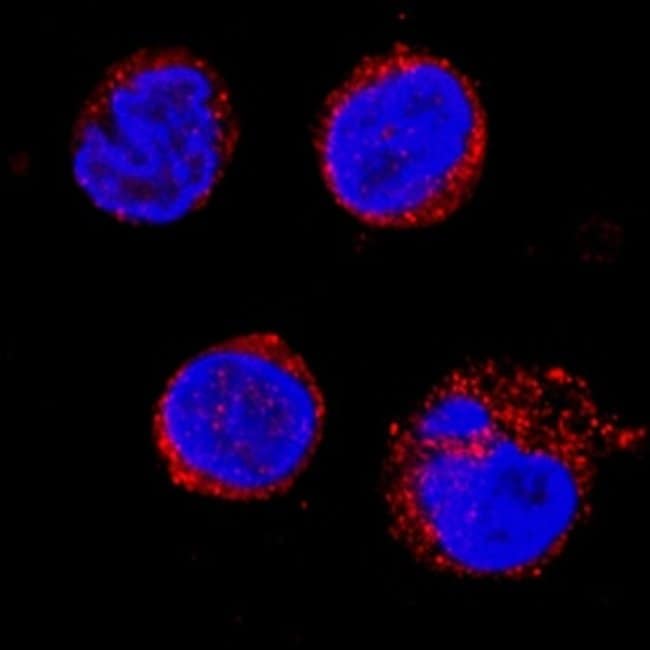
Human Cathepsin D Antibody, R&D Systems™

Mouse Monoclonal Antibody
214.00 € - 403.00 €
Specifications
| Antigen | Cathepsin D |
|---|---|
| Clone | 984824 |
| Dilution | Immunocytochemistry 8-25 ug/mL |
| Applications | Immunocytochemistry |
| Classification | Monoclonal |
| Product Code | Brand | Quantity | Price | Quantity & Availability | |||||
|---|---|---|---|---|---|---|---|---|---|
| Product Code | Brand | Quantity | Price | Quantity & Availability | |||||
|
18738189
|
R&D Systems
MAB10141-SP |
25 μg |
214.00 €
25µg |
Please sign in to purchase this item. Need a web account? Register with us today! | |||||
|
18700979
|
R&D Systems
MAB10141-100 |
100 μg |
403.00 €
100µg |
Please sign in to purchase this item. Need a web account? Register with us today! | |||||
Description
Cathepsin D Monoclonal specifically detects Cathepsin D in Human samples. It is validated for Immunocytochemistry.Specifications
| Cathepsin D | |
| Immunocytochemistry 8-25 ug/mL | |
| Monoclonal | |
| Supernatant | |
| Human | |
| P07339 | |
| 1509 | |
| IgG2b | |
| Protein A or G purified from hybridoma culture supernatant | |
| Use a manual defrost freezer and avoid repeated freeze-thaw cycles. 12 months from date of receipt, -20 to -70 degreesC as supplied. 1 month, 2 to 8 degreesC under sterile conditions after reconstitution. 6 months, -20 to -70 degreesC under sterile conditions after reconstitution. |
| 984824 | |
| Immunocytochemistry | |
| Unconjugated | |
| Mouse | |
| Lyophilized from a 0.2 μm filtered solution in PBS with Trehalose. *Small pack size (SP) is supplied as a 0.2 μm filtered solution in PBS. | |
| cathepsin D, cathepsin D (lysosomal aspartyl protease), CPSD, CTSD, EC 3.4.23, EC 3.4.23.5, lysosomal aspartyl peptidase, lysosomal aspartyl protease, MGC2311, neuronal 10 | |
| Mouse myeloma cell line NS0-derived recombinant human Cathepsin D Leu21-Leu412 Accession # P07339 | |
| Primary | |
| Reconstitute at 0.5 mg/mL in sterile PBS. | |
| Detects human Cathepsin D in direct ELISAs. |
Spot an opportunity for improvement?Share a Content Correction
Product Content Correction
Your input is important to us. Please complete this form to provide feedback related to the content on this product.
Product Title