Learn More


Invitrogen™ KDEL Polyclonal Antibody

Description
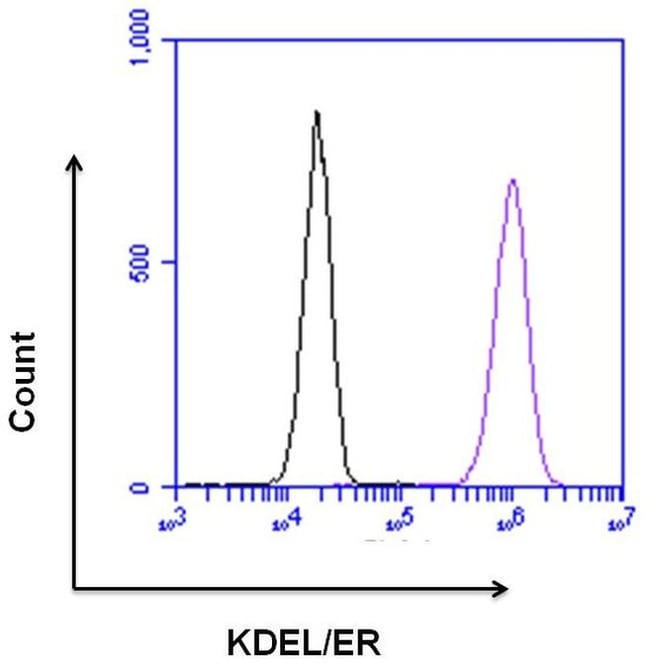
PA1-013 detects KDEL from human, rat, mouse and hamster. PA1-013 has been successfully used in Western blot, immunofluorescence and immunoprecipitation procedures. By Western blot, this antibody detects a 57 kDa protein representing protein disulfide isomerase (PDI), a 78 kDa protein representing glucose regulated protein 70 kDa (GRP78) and an ~94 kDa protein representing GRP94 in mouse myeloma cells. Immunofluorescence staining of GRP78 in mouse myeloma cells with PA1-013 results in diffuse cytoplasmic staining consistent with specific ER localization. PA1-013 immunoprecipitates PDI, GRP78, an ~72 kDa protein which may be endoplasmic reticulum protein 72 kDa (ERp72), and an ~94 kDa protein representing GRP94 from numerous rodent tissues. The PA1-013 immunogen is a synthetic peptide corresponding to residues C T(643) G E E D T S E K D E L(654) of rat GRP94. Reconstitute in 100 μL PBS to create a stock of 1 mg/mL.

Spécification
Spécification
| Antigen | KDEL |
| Applications | Flow Cytometry, Immunohistochemistry (Paraffin), Immunoprecipitation, Western Blot, Immunocytochemistry |
| Classification | Polyclonal |
| Concentration | 1 mg/mL |
| Conjugate | Unconjugated |
| Formulation | PBS with no preservative |
| Gene | Hsp90b1 |
| Gene Accession No. | P06761, P08113, P11021, P14625, P20029, P24390, Q569A6, Q66HD0, Q99JH8 |
| Gene Alias | 78 kDa glucose-regulated protein; 8030486F04Rik; 94 kDa glucose-regulated protein; 94 kDa glucose-regulated protein {ECO:0000250; AL022860; AU019543; AW215843; baffled; Binding-immunoglobulin protein; BiP; D2Wsu141e; D2Wsu17e; ECGP; Endoplasmic reticulum chaperone BiP; endoplasmic reticulum lumenal Ca(2+)-binding protein grp78; endoplasmic reticulum resident protein 58; Endoplasmic reticulum resident protein 99; Endoplasmin; endoplasmin {ECO:0000250; endothelial cell (HBMEC) glycoprotein; EP58; epididymis luminal protein 35; epididymis secretory sperm binding protein Li 125m; epididymis secretory sperm binding protein Li 89n; ER lumen protein retaining receptor 1; ER lumen protein-retaining receptor 1; ER protein 58; ERD2; Erd2.1; ERp58; ERp99; glucose regulated protein, 78 kDa; glucose-regulated protein; glucose-regulated protein, 78kDa; gp96; gp96 homolog; GRP 78; Grp78; GRP-78; GRP94; GRP-94; HDEL; heat shock 70 kDa protein 5; heat shock 70kD protein 5; heat shock 70kD protein 5 (glucose-regulated protein, 78kD); heat shock 70kDa protein 5 (glucose-regulated protein); heat shock 70kDa protein 5 (glucose-regulated protein, 78kDa); heat shock protein 5; Heat shock protein 70 family protein 5; heat shock protein 90 beta family member 1; heat shock protein 90 kDa beta member 1; heat shock protein 90 kDa beta member 1 {ECO:0000250; heat shock protein 90, beta (Grp94), member 1; heat shock protein 90, beta, member 1; heat shock protein 90kDa beta (Grp94), member 1; heat shock protein 90kDa beta family member 1; heat shock protein family A (Hsp70) member 5; Heat shock protein family A member 5; HEL35; HEL-S-125m; HEL-S-89n; Hsce70; HSP70 family protein 5; Hsp90b1; hsp90b1 {ECO:0000250; HSPA5; I79_019946; I79_020931; Immunoglobulin heavy chain-binding protein; KDEL; KDEL (Lys-Asp-Glu-Leu) containing 1; KDEL (Lys-Asp-Glu-Leu) endoplasmic reticulum protein retention receptor 1; KDEL endoplasmic reticulum protein retention receptor 1; KDEL motif containing 1; KDEL motif-containing 1; KDEL motif-containing protein 1; KDEL receptor 1; KDEL1; KDELC1; KDELR1; Lys-Asp-Glu-Leu; mBiP; MIF2; PM23; POGLUT2; Polymorphic tumor rejection antigen 1; Protein O-glucosyltransferase 2; Protein O-xylosyltransferase POGLUT2; Putative MAPK-activating protein PM23; RP23-446N16.1; Sez7; SEZ-7; Steroidogenesis-activator polypeptide; stress-inducible tumor rejection antigen gp96; TA-3; Targ2; Tra1; Tra-1; transforming growth factor alpha regulated gene 2; tumor rejection antigen (gp96) 1; tumor rejection antigen 1; Tumor rejection antigen gp96; UniProtKB:P08113}; UNQ1910/PRO4357; XAP-1 antigen |
| Gene Symbols | Hsp90b1, HSPA5, Kdelr1 |
| Afficher plus |
En cliquant sur Soumettre, vous reconnaissez que vous pouvez être contacté par Fisher Scientific au sujet des informations que vous avez fournies dans ce formulaire. Nous ne partagerons pas vos informations à d'autres fins. Toutes les informations de contact fournies seront également conservées conformément à notre politique de confidentialité. Politique de confidentialité.