missing translation for 'onlineSavingsMsg'
Learn More
Learn More
Invitrogen™ Ly-6G Monoclonal Antibody (1A8-Ly6g), Brilliant Ultra Violet™ 563, eBioscience™
Rat Monoclonal Antibody
Brand: Invitrogen™ 365-9668-80
This item is not returnable.
View return policy
Description
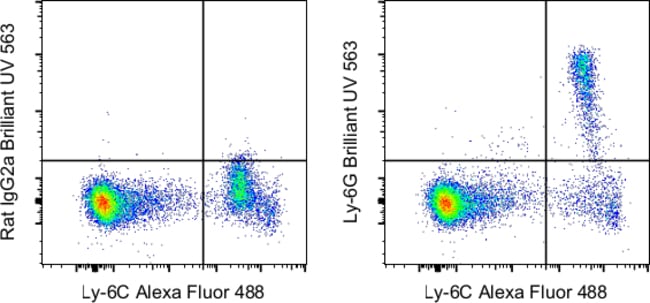
Description The monoclonal antibody 1A8-Ly6g reacts with mouse Ly-6G, which is also known as Gr-1. Ly-6G is a 25-kDa GPI protein expressed exclusively by neutrophils. Studies suggest an important role in neutrophil infiltration, recruitment and migration. Ly-6G associates with B2 integrins CD11a and CD11b and can attenuate B2 integrin expression and function. The ligand for Ly-6G is currently unknown. Unlike the RB6-8C5 antibody, 1A8-Ly6g is reported to only bind to Ly-6G found on neutrophils. Moreover, 1A8-Ly6g has been used to deplete neutrophils and reported to have antagonist activity. Applications Tested This 1A8-Ly6g antibody has been tested by flow cytometric analysis of mouse bone marrow cells. This may be used at less than or equal to 1.0 μg per test. A test is defined as the amount (μg) of antibody that will stain a cell sample in a final volume of 100 μL. Cell number should be determined empirically but can range from 10^5 to 10^8 cells/test. It is recommended that the antibody be carefully titrated for optimal performance in the assay of interest. Blocking Buffers When using two or more Super Bright, Brilliant Violet™, Brilliant Ultra Violet™, or other polymer dye-conjugated antibodies in a staining panel, it is recommended to use Super Bright Complete Staining Buffer (Product # SB-4401) or Brilliant Stain Buffer (Product # 00-4409-75) to minimize any non-s...
Ly6G (Lymphocyte antigen 6 complex locus G6D) is a component of the myeloid differentiation antigen Gr-1, together with Ly6C. The Ly6G protein has a molecular weight of approximately 21-25 kDa and is expressed by myeloid derived cells in the bone marrow. Ly6G is a good marker for detection of peripheral neutrophils, monocytes and granulocytes. Expression of Gr-1 in bone marrow correlates with granulocyte differentiation and maturation. The physiological role of Ly6G remains unclear but studies have shown its involvement in anti-tumor response, and studies with neutrophils suggest that Ly6G ligation may have an inhibitory effect on local immune responses.
Specifications
| Ly-6G | |
| Monoclonal | |
| 0.2 mg/mL | |
| PBS with BSA and 0.09% sodium azide; pH 7.2 | |
| P35461 | |
| Ly6g | |
| Affinity chromatography | |
| RUO | |
| 546644 | |
| 4°C, store in dark, DO NOT FREEZE! | |
| Liquid |
| Flow Cytometry | |
| 1A8-Ly6g | |
| Brilliant Ultraviolet 563 | |
| Ly6g | |
| Gr1; Gr-1; Ly6g; Ly-6G; ly-6G.1; lymphocyte antigen 6 complex, locus G; lymphocyte antigen 6G | |
| Rat | |
| 25 μg | |
| Primary | |
| Mouse | |
| Antibody | |
| IgG2a κ |
Product Content Correction
Your input is important to us. Please complete this form to provide feedback related to the content on this product.
Product Title
Spot an opportunity for improvement?Share a Content Correction