missing translation for 'onlineSavingsMsg'
Learn More
Learn More
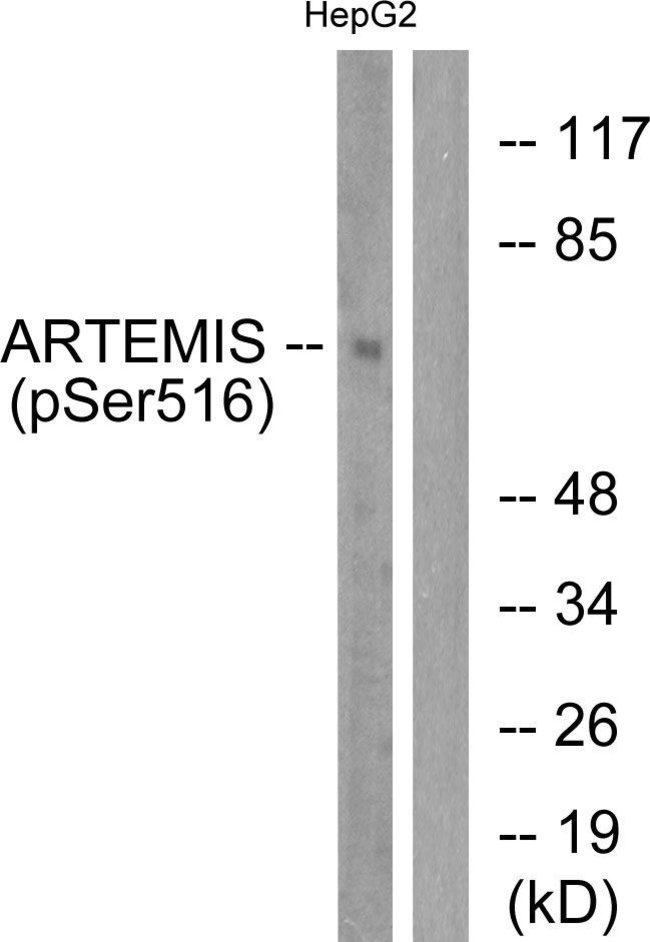
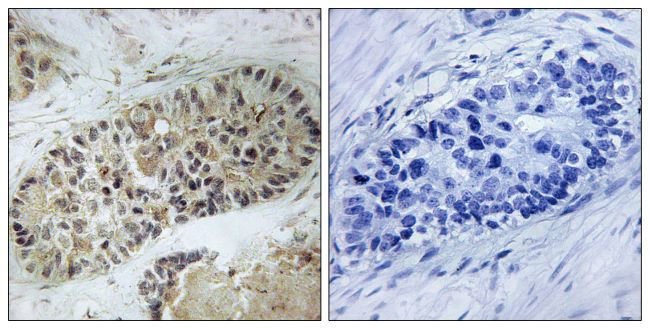
Phospho-Artemis (Ser516) Polyclonal Antibody, Invitrogen™
Description
Distinct DNA repair pathways minimize the consequences of mutagenic events. Reactive oxygen species (ROS) are highly reactive atoms with an unpaired electron that are conducive to double-strand DNA breaking events. Artemis, named after the Greek goddess for the protection of children, is one of the major proteins contributing to the preservation of double-strand breaks in DNA by cutting away the damaged parts of the DNA, which allows the strands to rejoin. Artemis is a single-strand-specific 5′ to 3′ exonuclease that forms a complex with the 469 kDa DNA-dependent protein kinase (DNA-PKcs). DNA-PKcs phosphorylates Artemis, and Artemis acquires endonucleolytic activity on 5′ and 3′ overhangs and hairpins. These activities are essential for V(D)J recombination and for the 5′ and 3′ overhang processing in nonhomologous DNA end joining.

Specifications
Specifications
| Antigen | Phospho-Artemis (Ser516) |
| Applications | Immunohistochemistry (Paraffin), Western Blot |
| Classification | Polyclonal |
| Concentration | 1 mg/mL |
| Conjugate | Unconjugated |
| Formulation | Dulbecco′s PBS with 150mM NaCl, 50% glycerol and 0.02% sodium azide; pH 7.4 |
| Gene | DCLRE1C |
| Gene Accession No. | Q96SD1, Q8K4J0 |
| Gene Alias | Protein artemis, DNA cross-link repair 1C protein, Protein A-SCID, SNM1 homolog C, hSNM1C, SNM1-like protein, DCLRE1C, ARTEMIS, ASCID, SCIDA, SNM1C |
| Gene Symbols | DCLRE1C |
| Show More |
Product Title
By clicking Submit, you acknowledge that you may be contacted by Fisher Scientific in regards to the feedback you have provided in this form. We will not share your information for any other purposes. All contact information provided shall also be maintained in accordance with our Privacy Policy.
Spot an opportunity for improvement?