missing translation for 'onlineSavingsMsg'
Learn More

Invitrogen™ TCR alpha/beta Monoclonal Antibody (IP26), NovaFluor™ UV 765, eBioscience™

Product Code. 30565093
Change view
Click to view available options
Quantity:
100 Tests
25 Tests
Unit Size:
Pack of 100
Pack of 25
2 product options available for selection
Product selection table with 2 available options. Use arrow keys to navigate and Enter or Space to select.
Product Code. Quantity unitSize
30565093 25 Tests Pack of 25
30565132 100 Tests Pack of 100
Use arrow keys to navigate between rows. Press Enter or Space to select a product option. 2 options available.
2 options
This item is not returnable. View return policy
Product Code. 30565093 Supplier Invitrogen™ Supplier No. H086T02U01A

Please to purchase this item. Need a web account? Register with us today!

This item is not returnable. View return policy

Mouse Monoclonal Antibody

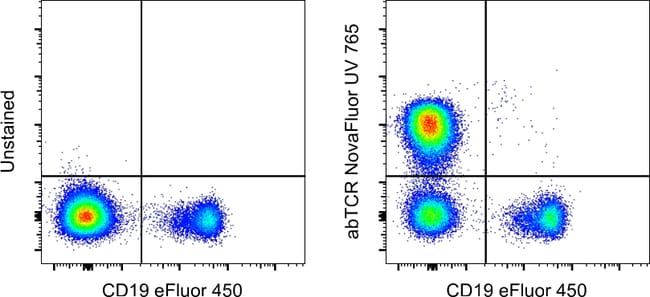
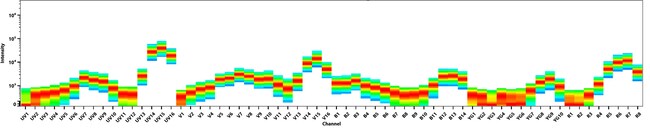
Description: The IP26 monoclonal antibody reacts with the alpha beta chain of human TCR.The alpha beta TCR is expressed by the majority of peripheral T cells. This product contains 1 vial of NovaFluor conjugate and 1 vial of CellBlox Plus Blocking Buffer. Applications Tested: This IP26 antibody has been pre-titrated and tested by flow cytometric analysis of human peripheral blood cells. This can be used at 5 μL (0.6 μg) per test. A test is defined as the amount (μg) of antibody that will stain a cell sample in a final volume of 100 μL. Cell number should be determined empirically but can range from 10^5 to 10^8 cells/test. Staining with the IP26 antibody can be obstructed when OKT3 (anti-human CD3) antibody is used as a co-stain Master mixes. Whole Blood compatibility: When utilizing whole blood (as opposed to density-gradient-purified PBMC), we recommend lysing red blood cells in bulk prior to staining with NovaFluor conjugates.

The T cell antigen receptor (TCR) consists of a ligand-specific alpha/beta heterodimer non-covalently associated with five invariant chains including the CD3 gamma/delta/eta and zeta subunits, all of which are required for efficient surface expression. T cell activation through the TCR induces cellular differentiation and/or proliferation and the production of lymphokines and cytokines. Both the CD3 and TCR zeta subunits are proposed to be responsible for the intracellular signal transduction events. Majority of T cells present in the blood, lymph and secondary lymphoid organs express TCR alpha/beta heterodimers, whereas the T cells expressing TCR gamma/delta heterodimers are localized mainly in epithelial tissues and at the sites of infection. The subunits of TCR heterodimers are covalently bonded and associate with the CD3 subunits in the endoplasmic reticulum to form functional TCR-CD3 complex. Lack of expression of any of the chains is sufficient to stop cell surface expression. The ability of T cell receptors (TCR) to discriminate foreign from self-peptides presented by major histocompatibility complex (MHC) class II molecules is essential for an effective adaptive immune response. TCR recognition of self-peptides has been linked to autoimmune disease. Mutant self-peptides have been associated with tumors. Engagement of TCRs by a family of bacterial toxins know as superantigens has been responsible for toxic shock syndrome. Autoantibodies to V beta segments of T cell receptors have been isolated from patients with rheumatoid arthritis (RA) and systemic lupus erythematosus (SLE). The autoantibodies block TH1-mediated inflammatory auto-destructive reactions and are believed to be a method by which the immune system compensates for disease (ref5). T Cell and TCR Diversity Most human T cells express the TCR alpha-beta and either CD4 or CD8 molecule (single positive, SP). A small number of T cells lack both CD4 and CD8 (double negative, DN). Increased percentages of alpha-beta DN T cells have been identified in some autoimmune and immunodeficiency disorders. Gamma-delta T cells are primarily found within the epithelium. They show less TCR diversity and recognize antigens differently than alpha-beta T cells. Subsets of gamma-delta T cells have shown antitumor and immunoregulatory activity.
TRUSTED_SUSTAINABILITY

Specifications

Antigen TCR alpha/beta
Applications Flow Cytometry
Classification Monoclonal
Clone IP26
Concentration 0.6 μg/Test
Conjugate NovaFluor UV 765
Formulation PBS with BSA and 0.09% sodium azide; pH 7.2
Gene TRAC
Gene Accession No. P01848, P04435, P0DSE1, P0DSE2
Gene Alias FLJ22602; IMD7; LOC290071; MGC117436; MGC22624; MGC23964; MGC71411; RATTCB; RATTCBC1; RGD1359684; similar to RIKEN cDNA A430107P09 gene; T cell receptor beta locus; T3/TCR complex; TCB; TCBC1; t-cell antigen receptor; T-cell receptor alpha constant; T-cell receptor beta chain; T-cell receptor V alpha; tcr alpha; TCR alpha/ beta; TCR beta; TCRA; Tcrb; TRA; Tra29; TRAC; TRB; TRB@; TRCA
Gene Symbols TRA, TRAC, TRB, TRBV7-9
Host Species Mouse
Purification Method Affinity chromatography
Quantity 25 Tests
Regulatory Status RUO
Primary or Secondary Primary
Gene ID (Entrez) 28589, 28755, 6955, 6957
Target Species Human
Content And Storage 4°C, store in dark, DO NOT FREEZE!
Product Type Antibody
Form Liquid
Isotype IgG1 κ
Afficher plus Afficher moins
Nom du produit
Sélectionnez un problème

En cliquant sur Soumettre, vous reconnaissez que vous pouvez être contacté par Fisher Scientific au sujet des informations que vous avez fournies dans ce formulaire. Nous ne partagerons pas vos informations à d'autres fins. Toutes les informations de contact fournies seront également conservées conformément à notre politique de confidentialité. Politique de confidentialité.