missing translation for 'onlineSavingsMsg'
Learn More
Learn More
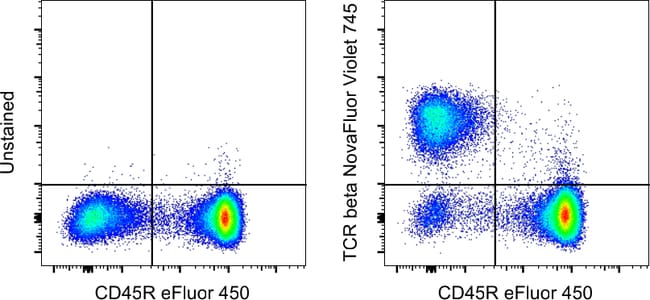
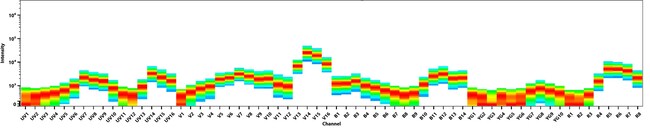
Invitrogen™ TCR beta Monoclonal Antibody (H57-597), NovaFluor™ Violet 745
Armenian Hamster Monoclonal Antibody
202.00 € - 409.00 €
Specifications
| Antigen | TCR beta |
|---|---|
| Clone | H57-597 |
| Content And Storage | 4°C, store in dark, DO NOT FREEZE! |
| Applications | Flow Cytometry |
| Classification | Monoclonal |
| Product Code | Brand | Quantity | Price | Quantity & Availability | |||||
|---|---|---|---|---|---|---|---|---|---|
| Product Code | Brand | Quantity | Price | Quantity & Availability | |||||
|
30484956
|
Invitrogen™
M013T02V02-A |
25 μg |
202.00 €
25µg |
Please sign in to purchase this item. Need a web account? Register with us today! | |||||
|
30484858
|
Invitrogen™
M013T03V02-A |
100 μg |
409.00 €
100µg |
Please sign in to purchase this item. Need a web account? Register with us today! | |||||
Description
Description: The H57-597 monoclonal antibody reacts with the beta chain of mouse TCR. TCR beta is expressed by thymocytes in a developmentally regulated manner and a majority of peripheral T cells. Crosslinking of the TCR complex with H57-597 induces activation and proliferation of T cells or apoptosis based on assay conditions. H57-597 is used as a phenotypic marker for TCR beta expressing T cells. This product contains 1 vial of NovaFluor conjugate and 1 vial of CellBlox Plus Blocking Buffer. Applications Tested: The H57-597 antibody has been tested by flow cytometric analysis of mouse thymocytes and splenocytes. This can be used at less than or equal to 0.6 μg per test. A test is defined as the amount (μg) of antibody that will stain a cell sample in a final volume of 100 μL. Cell number should be determined empirically but can range from 10^5 to 10^8 cells/test. It is recommended that the antibody be carefully titrated for optimal performance in the assay of interest Master mixes.
The ability of T cell receptors (TCR) to discriminate foreign from self-peptides presented by major histocompatibility complex (MHC) class II molecules is essential for an effective adaptive immune response. TCR recognition of self-peptides has been linked to autoimmune disease. Mutant self-peptides have been associated with tumors. Engagement of TCRs by a family of bacterial toxins know as superantigens has been responsible for toxic shock syndrome. Autoantibodies to V beta segments of T cell receptors have been isolated from patients with rheumatoid arthritis (RA) and systemic lupus erythematosus (SLE). The autoantibodies block TH1-mediated inflammatory autodestructive reactions and are believed to be a method by which the immune system compensates for disease (ref5). T Cell and TCR Diversity Most human T cells express the TCR alpha-beta and either CD4 or CD8 molecule (single positive, SP). A small number of T cells lack both CD4 and CD8 (double negative, DN). Increased percentages of alpha-beta DN T cells have been identified in some autoimmune and immunodeficiency disorders. Gamma-delta T cells are primarily found within the epithelium. They show less TCR diversity and recognize antigens differently than alpha-beta T cells. Subsets of gamma-delta T cells have shown antitumor and immunoregulatory activity.Specifications
| TCR beta | |
| 4°C, store in dark, DO NOT FREEZE! | |
| Monoclonal | |
| Liquid | |
| IgG | |
| Mouse | |
| Tcrb | |
| 21577 | |
| Primary | |
| Affinity chromatography |
| H57-597 | |
| Flow Cytometry | |
| NovaFluor Violet 745 | |
| Armenian Hamster | |
| RUO | |
| PBS with BSA and 0.09% sodium azide; pH 7.2 | |
| bTCR; FLJ22602; MGC117436; MGC22624; MGC23964; MGC71411; T cell receptor beta chain; t-cell antigen receptor; T-cell receptor; TCR beta; Tcra; Tcrb; TCRbeta; TCRD; Tib; TRA | |
| Tcrb | |
| Antibody |
Spot an opportunity for improvement?Share a Content Correction
Product Content Correction
Your input is important to us. Please complete this form to provide feedback related to the content on this product.
Product Title